Jonas Schmid · 17 October 2026
Adapting Backend Architectures for Seamless Third-Party App Integrations in Independent Retail Platforms
Independent retail platforms face increasing demands to connect with external applications that handle inventory tracking, payment processing, customer analytics, and marketing automation while maintaining operational stability. Backend systems must evolve from rigid structures to flexible frameworks that support these connections without introducing latency or data inconsistencies. Data from industry analyses indicates that platforms adopting modular designs achieve higher integration success rates because they isolate core functions from third-party dependencies.
Core Components of Adaptable Backend Systems
Modern architectures rely on standardized interfaces such as RESTful APIs and GraphQL endpoints that allow third-party developers to access specific data subsets without full system exposure. These interfaces operate alongside event-driven mechanisms like webhooks that push updates in real time when inventory levels change or orders process. Observers note that platforms using both synchronous and asynchronous communication patterns reduce bottlenecks during peak shopping periods because requests queue efficiently rather than overwhelming primary servers.
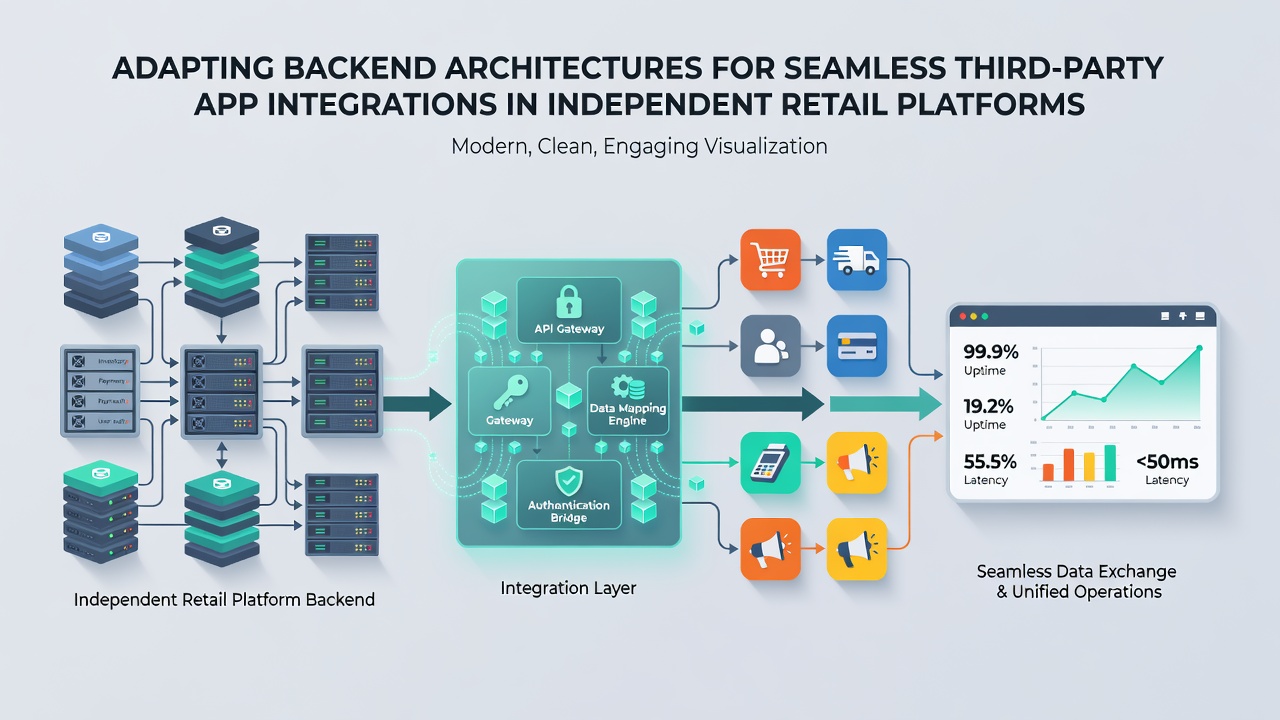
Microservices decomposition plays a central role in this adaptation because each service manages a distinct domain such as user authentication or product cataloging. When a third-party analytics tool integrates, it connects only to the relevant microservice rather than the entire monolith, limiting potential failure points. Research from academic institutions across North America shows that teams deploying container orchestration tools like Kubernetes maintain uptime above 99.5 percent during integration rollouts since isolated services restart independently.
Data Synchronization and Security Protocols
Seamless integrations require consistent data flows between the retail platform and external applications, often achieved through middleware layers that normalize formats from disparate sources. As of October 2026, updates to open standards have improved compatibility for formats like JSON and Avro, allowing faster mapping of product attributes across systems. Security remains paramount because third-party access introduces additional vectors; token-based authentication combined with role-based permissions ensures that apps receive only the minimum data necessary for their functions.
Encryption standards such as TLS 1.3 protect data in transit while database-level controls restrict queries from untrusted sources. Figures from regulatory bodies in the European Union reveal that platforms implementing these layered protections experience fewer compliance incidents when connecting to payment gateways or loyalty programs. Those who have studied implementation timelines find that phased rollouts, starting with read-only endpoints before expanding to write capabilities, allow teams to identify issues early without disrupting live sales operations.
Scalability Considerations in Growing Retail Environments
Independent retailers often begin with straightforward database setups yet must scale as order volumes rise and new apps join the ecosystem. Load balancing across multiple backend instances distributes integration traffic evenly, while caching layers store frequently accessed data from third-party sources to cut response times. Studies conducted by research groups in Australia demonstrate that platforms incorporating auto-scaling policies handle sudden spikes from marketing app campaigns without manual intervention because resource allocation adjusts dynamically based on queue depths.
Version control for APIs prevents breaking changes when external developers update their applications. Backward-compatible endpoints coexist with newer versions so that legacy integrations continue functioning while newer ones leverage enhanced features. This approach supports long-term platform growth because developers can deprecate old methods gradually rather than forcing immediate updates across all connected apps.
Practical Implementation Patterns Observed in Retail Platforms
One documented case involved a regional clothing retailer that transitioned its monolithic backend to a service-oriented model over eighteen months. The shift enabled direct connections to a shipping carrier's tracking service and a customer review aggregator without custom code for each addition. Data synchronization routines ran every fifteen minutes initially then moved to event-based triggers once monitoring confirmed stability. Similar patterns appear in platforms serving specialty food vendors where integration with supplier databases occurs through scheduled ETL processes that respect rate limits imposed by external systems.
Monitoring tools track integration health through metrics such as request latency, error rates, and throughput. Dashboards aggregate these signals so operations teams can isolate whether slowdowns originate from the core platform or a connected application. Evidence from Canadian trade associations indicates that proactive alerting on these metrics reduces mean time to resolution for integration-related issues by approximately forty percent compared with reactive troubleshooting.
Conclusion
Adapting backend architectures for third-party integrations centers on modular design, secure interfaces, and scalable infrastructure that accommodates evolving retail needs. Platforms that prioritize these elements maintain reliable performance even as the number of connected applications grows. Continued adherence to emerging standards supports ongoing compatibility while protecting core business operations from external disruptions.